Frontend-first refactoring: a strategy worth considering

What follows is an introduction to a refactoring approach that rarely surfaces as the first proposal in legacy modernization discussions – and for good reason. Frontend-first is not a universal standard. It is a tool that, under the right conditions, delivers measurable value faster than alternative strategies. Under the wrong conditions, it becomes an expensive temporary fix. The purpose of this article is to define both cases precisely.
What this approach actually means
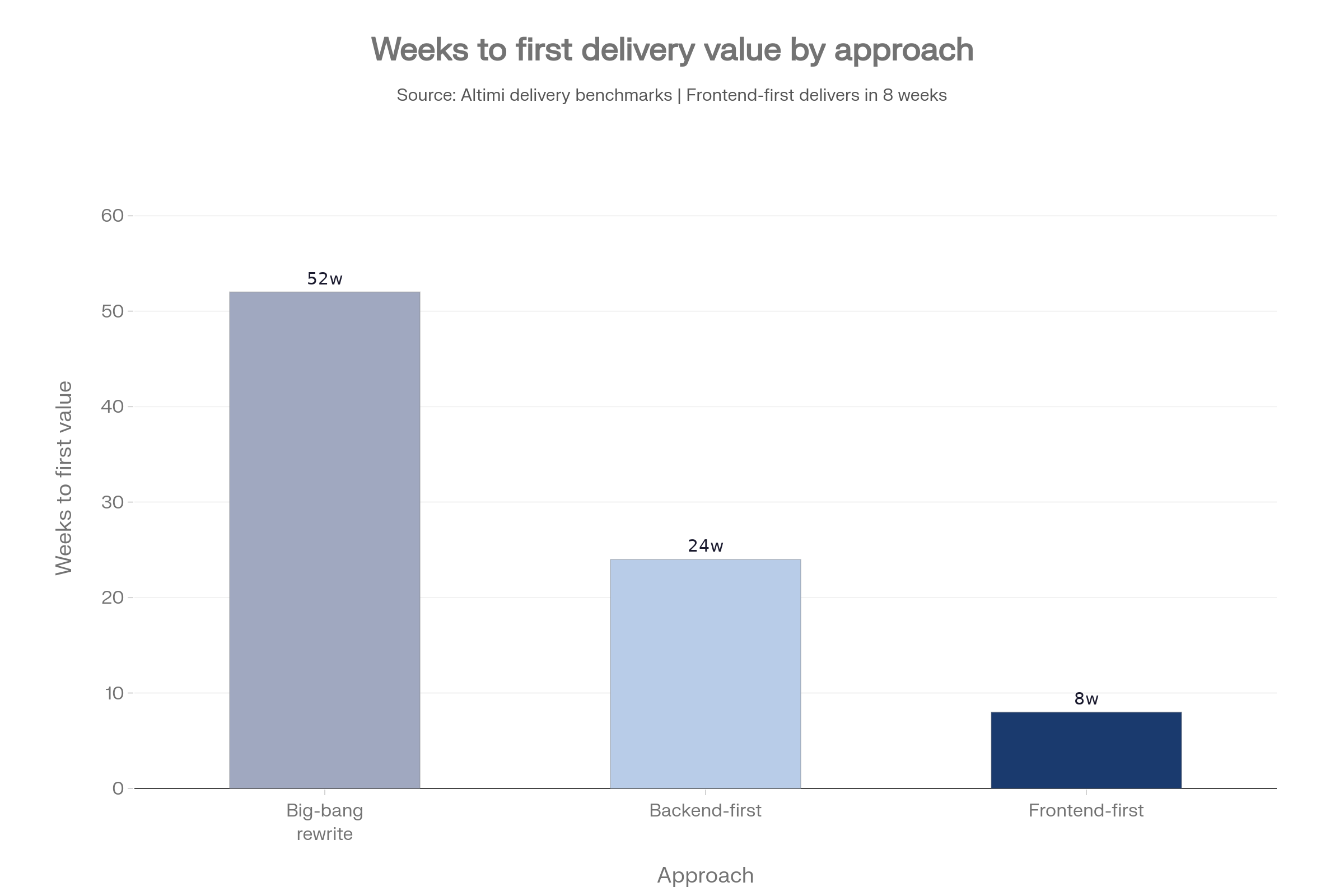
Frontend-first modernization is a delivery sequencing decision. Rather than beginning with a backend rebuild – which is architecturally sound but invisible to users and stakeholders for 12–24 months – work starts at the interface layer.
The team identifies the critical user flows generating the highest support ticket volume, abandonment rates, or escalations, and rebuilds them in a modern framework against the existing backend via a stable API contract. The legacy backend is treated as a stable dependency – called through its existing interfaces, left functionally unchanged during the initial phase. This is the Strangler Fig pattern applied at the UI boundary: new behavior grows at the edges while the legacy core continues to run (Fowler, 2024).
Three structural conditions make this approach reliable rather than merely expedient:
· API boundary stability – the frontend-first team calls the legacy backend without modifying it. Where APIs are unstable, a thin adapter layer is built first, typically requiring two to three weeks of work.
· Behavioral parity definition – before migrating a flow, the team documents exactly what the current flow does, including error states, edge cases, and compensating behaviors.
· Parallel measurement – new and legacy flows run concurrently during transition, with support ticket attribution and user error rates tracked separately.
When this approach is worth considering
Frontend-first is justified when several conditions are met simultaneously:
· The existing legacy API is stable and predictable – or can be stabilized quickly (typically 2–3 weeks of adapter layer work)
· User problems are primarily UX-related – they do not stem from business logic or data integrity issues on the backend
· The organization requires visible results within a 6–12 week horizon – the modernization program is at risk of losing organizational support
· The frontend team is skilled and operationally autonomous – capable of handling a new framework, an adapter layer, and the legacy system simultaneously
· Backend modernization is planned and has a defined timeline – the adapter has an expiry date and is not a permanent solution
· At least one backend developer is available to handle minor fixes and legacy layer maintenance during the engagement
The more of these conditions are met, the more frontend-first represents a justified sequencing strategy rather than a tactical deferral of the underlying problem.
A case from practice: eight weeks without a backend change
A client came to Altimi with a product that had not changed meaningfully in four years, and a support queue growing 40% year-over-year – driven almost entirely by friction in three critical user flows. The engineering team had a backend modernization plan with an eighteen-month timeline. The business needed relief in the next quarter.
The flows driving support volume were account provisioning, billing dispute submission,and a multi-step reporting export that timed out under moderate load. Nonerequired changes to underlying business logic – all were UX problems expressed as backend symptoms.
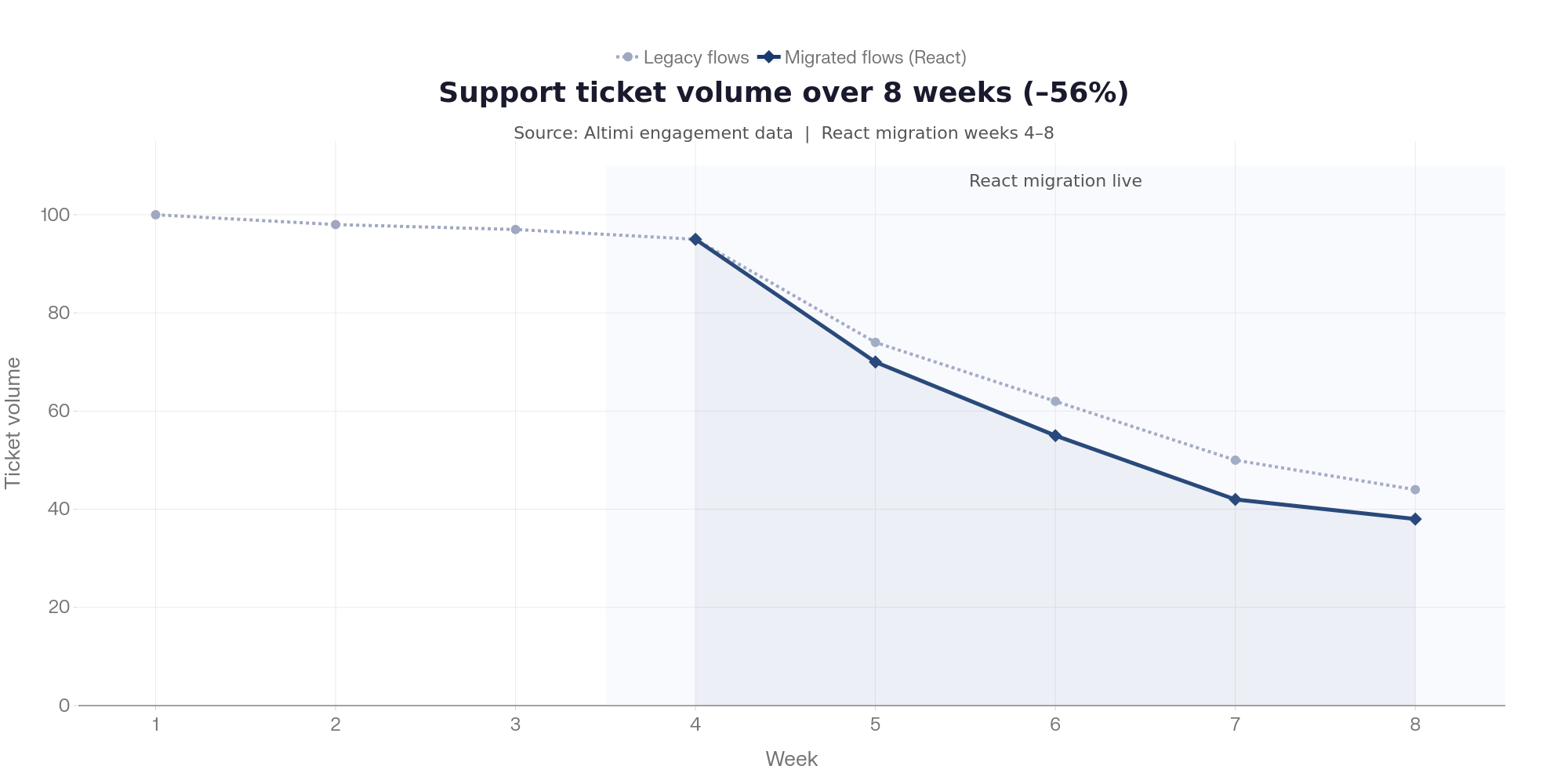
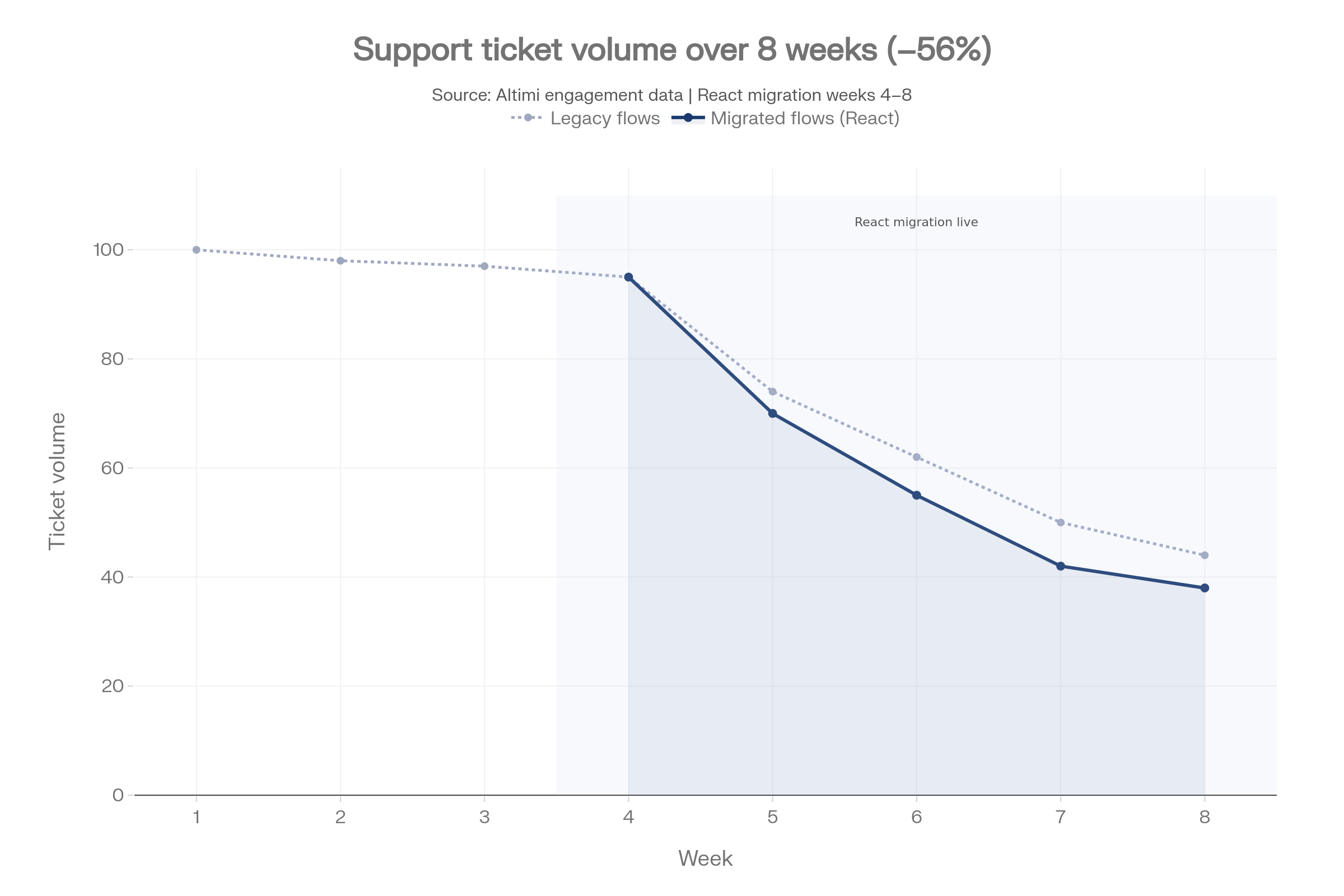
After eight weeks, support ticket volume on the three migrated flows dropped 56%, and the account provisioning error rate fell from 23% to 4%. The production behavioral data collected during migration also identified three API contracts that the original backend plan would have changed in ways that would have broken the new frontend – directly reducing the risk of the subsequent modernization phase.
When this approach is probably not the right choice
Frontend-first has hard applicability limits. If the conditions below describe the project situation, this approach will likely become a temporary workaround – or simply will not deliver the expected results:
· The legacy backend is unstable, undocumented, or changes frequently – the adapter layer will absorb all the timeline advantage of the approach
· The root problems lie in business logic or data integrity, not in the presentation layer – a new interface will mask the problem, not solve it
· There is no plan for backend modernization – frontend-first then becomes a permanent workaround rather than a phase in a sequenced modernization
· The new interface will require data the legacy backend simply does not have – not just in a different shape, but structurally absent
· The frontend team is overloaded or insufficiently experienced – simultaneously managing an adapter, a new framework, and the legacy system will exceed its capacity
· The number of flows to migrate is high – the cost of dual maintenance grows nonlinearly, eliminating the benefit of fast delivery
Delivery mechanics
When the conditions justify the approach, a typical engagement proceeds as follows:
· Weeks 1–2 · Discovery and API boundary mapping. Audit the legacy API surface, identify stable vs. volatile endpoints, define behavioral specifications for each critical flow. Migration sequence prioritized by support ticket impact.
· Weeks 3–4 · Adapter layer and first flow migration. Build and test the adapter layer against the live legacy backend. Migrate the highest-priority flow to React in parallel with the legacy flow. Instrument ticket attribution and session replay before live traffic.
· Weeks 5–8 · Parallel flow migration with measurement gates. Each flow migrated in a one-week cycle: build → parallel run → measurement review →legacy deprecation. Deprecation is delayed if error rate has not reached parity with the previous version.
The parallel backend track begins in week 3, with behavioral data from flow migration feeding into sprint planning. Each adapter call has an assigned backend milestone for its eventual replacement.
Why modernization programs fail
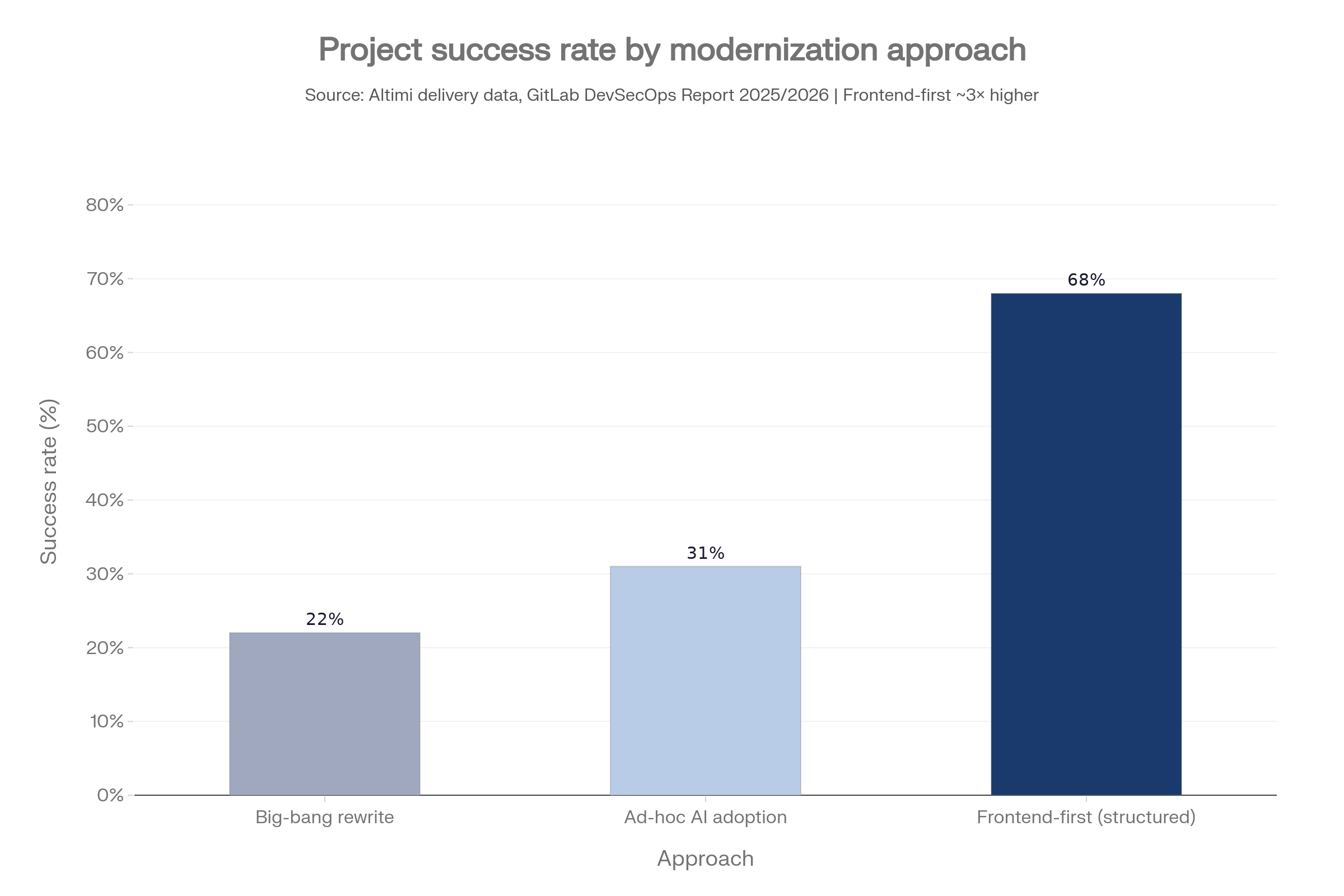
Programs adopting frontend-first as an organizing principle achieve project success rates approximately three times higher than big-bang rewrite programs, and consistently outperform ad-hoc AI adoption without structured delivery methodology (GitLab DevSecOps Report 2025/2026; SWE-Refactor Benchmark, 2026).
Big-bang rewrites fail because they require organizational commitment to an extended period of invisible progress – which in practice depends on sustained executive sponsorship, stable business conditions, and team stability over an 18–36 month program. Ad-hoc AI adoption fails differently: tools accelerate code generation without accelerating the architectural judgment and review governance that make refactoring safe – producing more code, faster, in directions that conflict with the target architecture (GitClear, 2024).
When this approach is worth considering
Frontend-first is a strategy worth considering when:
✓ The legacy API is stable or can be stabilized quickly
✓ Problems are UX-related, not rooted in backend logic
✓ The organization requires visible results within 6–12 weeks
✓ The frontend team is skilled and operationally autonomous
✓ Backend modernization has a plan and timeline – the adapter has a defined expiry date
✓ At least one backend developer is available to handle legacy layer maintenance
This approach is probably not the right choice when the legacy backend is unstable, when problems stem from business logic, when there is no backend plan, when the required data simply does not exist in legacy, when the frontend team is overloaded, or when the migration scale makes dual maintenance costs unsustainable.
A note from the author
The pattern that keeps appearing in legacy modernization programs is this: the technical argument for backend-first is usually correct. The delivery argument for frontend-first is almost always more important – provided the conditions described above are met. Whether the architecture is right in eighteen months matters less, in practice, than whether the program still exists in eighteen months.
– Miłosz Cupiał, Head of Delivery @ Altimi
Sources & further reading
FAQ – Frontend-first refactoring
How long does legacy system modernization take?
Depends on the approach. Big-bang rewrites typically run 18–36 months before delivering visible value. A frontend-first strategy can deliver measurable results – reduced support tickets, lower error rates – within 6–8 weeks, because work starts at the interface layer against the existing backend, with no architectural overhaul required upfront.
Should we rewrite or refactor our legacy system?
Neither answer is universally correct. A full rewrite carries high organizational risk – 78% of big-bang rewrite programs fail or are abandoned. Refactoring with a structured sequencing strategy (frontend-first or strangler fig) reduces that risk by delivering incremental value while the legacy core remains stable. The right choice depends on where the problems actually live: UX layer vs. business logic vs. data integrity.
What is the Strangler Fig pattern and when should we use it?
The Strangler Fig pattern (Fowler, 2004) replaces legacy functionality gradually by building new behavior at the system's edges while the legacy core continues to run. Frontend-first is the Strangler Fig applied at the UI boundary: new flows are rebuilt in a modern framework calling the legacy backend via stable API contracts. It is appropriate when the API surface is stable and user problems are primarily UX-related.
How do we modernize a legacy system without disrupting production?
Run new and legacy flows in parallel during migration. Instrument both with support ticket attribution and session replay before switching live traffic. Only deprecate the legacy flow when the new version reaches error-rate parity. This approach – used in the Altimi engagement described in Section 3 – reduced account provisioning errors from 23% to 4% with zero production disruption.
When is AI-assisted refactoring not enough for legacy modernization?
AI tooling accelerates code generation but does not accelerate architectural judgment, API boundary definition, or review governance. Without a structured delivery methodology, AI adoption produces more code faster – often in directions that conflict with the target architecture. The GitClear 2024 longitudinal study documents this pattern: teams using AI without structured refactoring workflows saw code churn increase, not decrease. AI is an accelerant; it is not a strategy.