AI-powered system for planning scenarios of clinical trials

We developed an advanced system for planning clinical trial scenarios. The system leverages AI and NLP to analyze large volumes of medical protocols, supports decision-making, and accelerates trial design.
Making Sense of Vast Clinical Data
Planning clinical trials requires answering critical questions: sample sizes, inclusion/exclusion criteria, and effectiveness/safety evaluation.
- Existing protocols were unstructured and too large for manual processing.
- The client lacked in-house experience with machine learning and NLP.
- The goal was to create a recommendation system to make trial planning faster, more reliable, and cost-efficient.
A human cannot easily process hundreds of thousands of clinical trial protocols. We needed structured AI solutions to extract meaningful insights from this data.

AI, NLP, and Modular Microservices
Named Entity Recognition (NER) with BERT
- Extracted key concepts from clinical trial documents (e.g., drug names, patient metrics).
- Used BERT-based transformer models fine-tuned on a large database of clinical protocols.
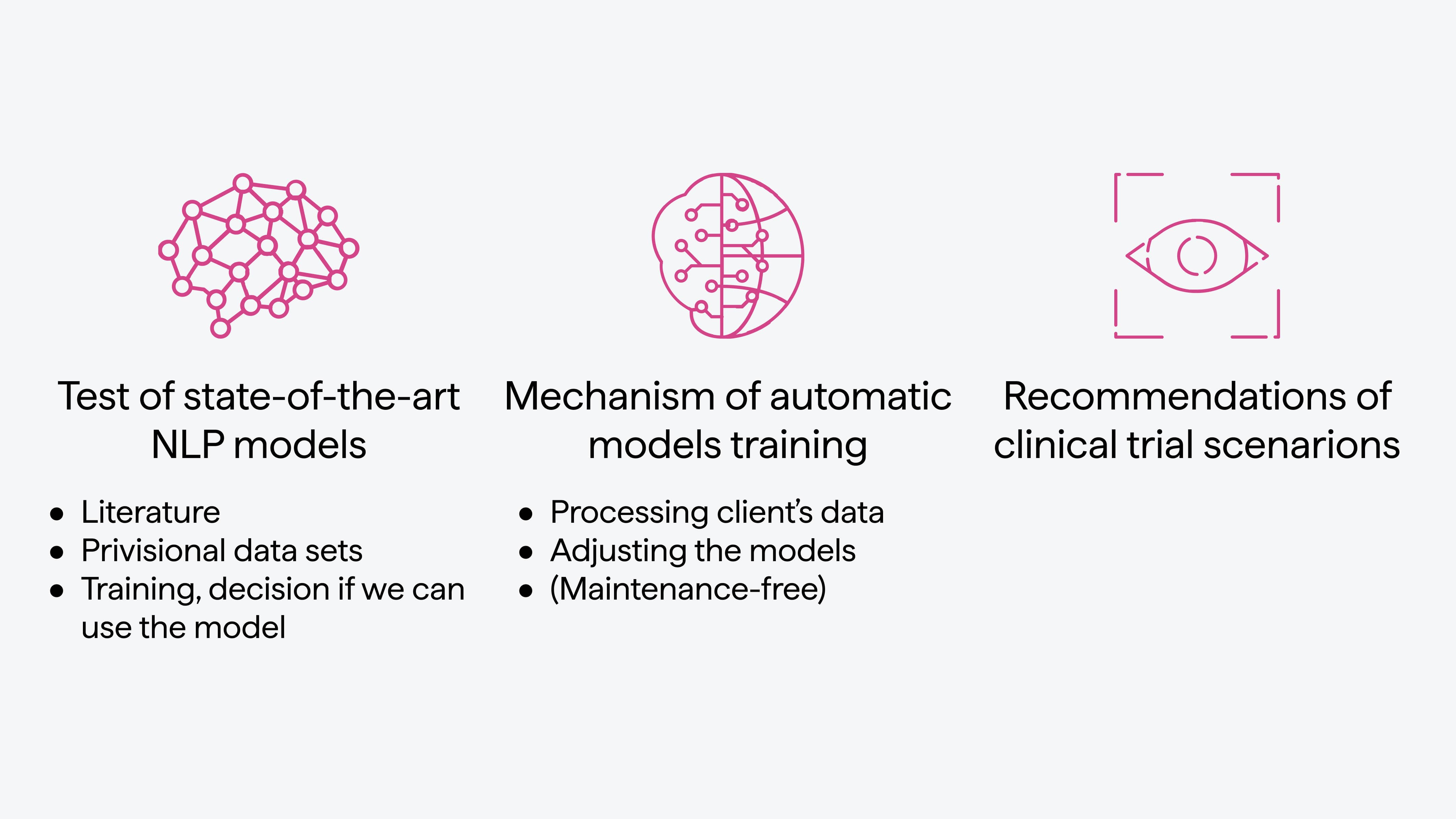
- Developed mechanisms to automate dataset creation for training models, speeding up model adaptation for new concepts.
Handcrafted Rules
- Applied rule-based methods using regular expressions and part-of-speech detection for predictable medical phrases.
- Built a flexible Python framework allowing domain experts to add custom rules easily.
Text Classification
- Assigned classes to text passages to identify study objectives and relevant sections of protocols.
- Used BERT-based models with context-sensitive representations, fine-tuned on hand-labeled datasets.
Modular Microservices Architecture
- Deployed scalable microservices for NER and text classification.
- Enabled iterative training, predictions, and continuous improvements.
- Integrated mobile-ready, user-friendly interfaces for analysts.
Faster, Smarter, and Scalable Clinical Trial Planning
By implementing the AI-powered system, the client achieved a 70% increase in the speed of data extraction from clinical trial protocols, enhanced the accuracy of information recognition by 90%, and streamlined the planning and analysis of trial scenarios, improving overall operational efficiency by 60%. This enabled faster, more reliable decision-making and reduced the time and cost required to design and execute clinical trials.
FAQ - AI in Clinical Trial Planning and Analysis
What are the benefits of using AI to analyze clinical trial protocols?
AI enables automatic processing of thousands of pages of documentation, identification of key information, and elimination of human errors. This makes protocol analysis faster, more accurate, and less burdensome for research teams.
What is NER (Named Entity Recognition) and why is it important in clinical trials?
NER automatically recognizes important elements in the text, such as drug names, patient parameters, or inclusion/exclusion criteria. This allows data to be immediately structured and ready for further analysis, significantly speeding up the trial planning process.
Can the system adapt to new protocols and medical terminology?
Yes. The system uses iterative training of BERT models and automatic generation of training datasets, allowing rapid adaptation to new concepts, regulatory changes, and the specifics of upcoming clinical trials.
Is integrating AI with existing clinical tools complicated?
Thanks to a microservices architecture, integration is simple and flexible. The system can operate as a standalone module or connect to existing platforms, minimizing disruption to current research processes.
Does the system supporting clinical trials comply with data security requirements?
Yes. The architecture is designed to meet data protection standards, including GDPR. Microservices and data pipelines can be deployed on-premises or in the cloud with access control, encryption, and activity logging.