Artificial intelligence in due diligence: organizational readiness and product resilience

.png)
AI is no longer a peripheral consideration in mergers, acquisitions, and investment processes – it sits at the center of how companies create value, compete, and scale. For investors and acquirers,understanding AI through two distinct lenses has become essential: how ready is a company to implement and leverage AI (AI Readiness), and how resilient is it sproduct or business model against AI-driven disruption (AI Resilience/Defensibility).
AI readiness: assessing a company's capacity to leverage AI
Evaluating an organization's readiness to implement and effectively utilize artificial intelligence reveals its potential for innovation, process optimization, and sustainable growth post-acquisition. Modern AI readiness frameworks assess several interconnected dimensions.
Business strategy and AI vision. A company's AI ambitions must be grounded in a clear, leadership-backed strategy that integrates with overall business objectives. The key question: does the executive team genuinely understand and actively champion AI initiatives or is AI treated as a technical experiment disconnected from core strategy?
Data management. AI is fundamentally data-driven. The assessment examines data quality, availability, structure, and governance. How is data collected, stored, cleaned, and secured? Are there established policies covering data privacy and regulatory compliance?
IT environment and security. Underlying infrastructure must be capable of supporting AI at scale – from compute capacity and cloud platforms to AI development tooling and cybersecurity protocols protecting sensitive data and models.
Risk, privacy, and corporate governance. AI implementation introduces ethical, legal, and operational risk. Mature organizations have AI risk management frameworks, GDPR-compliant data privacy policies, and oversight mechanisms ensuring responsible development and use.
Adoption and organizational culture. Technology alone does not determine AI success – people do. The assessment covers workforce skills, innovation culture, training programs, and the organization's demonstrated ability to absorb and act on AI-driven change.
A thorough evaluation across these dimensions enables investors to identify capability gaps and construct a realistic roadmap for post-acquisition value creation.
AI resilience: is the product future-proof against AI substitution?
As AI capabilities accelerate, a critical due diligence question emerges: could an AI-native competitor replace or meaningfully undercut this company's product? Warren Buffett's concept of an economic "moat" takes on new significance in this context. In an AI-driven market, defensibility can be assessed across five dimensions.
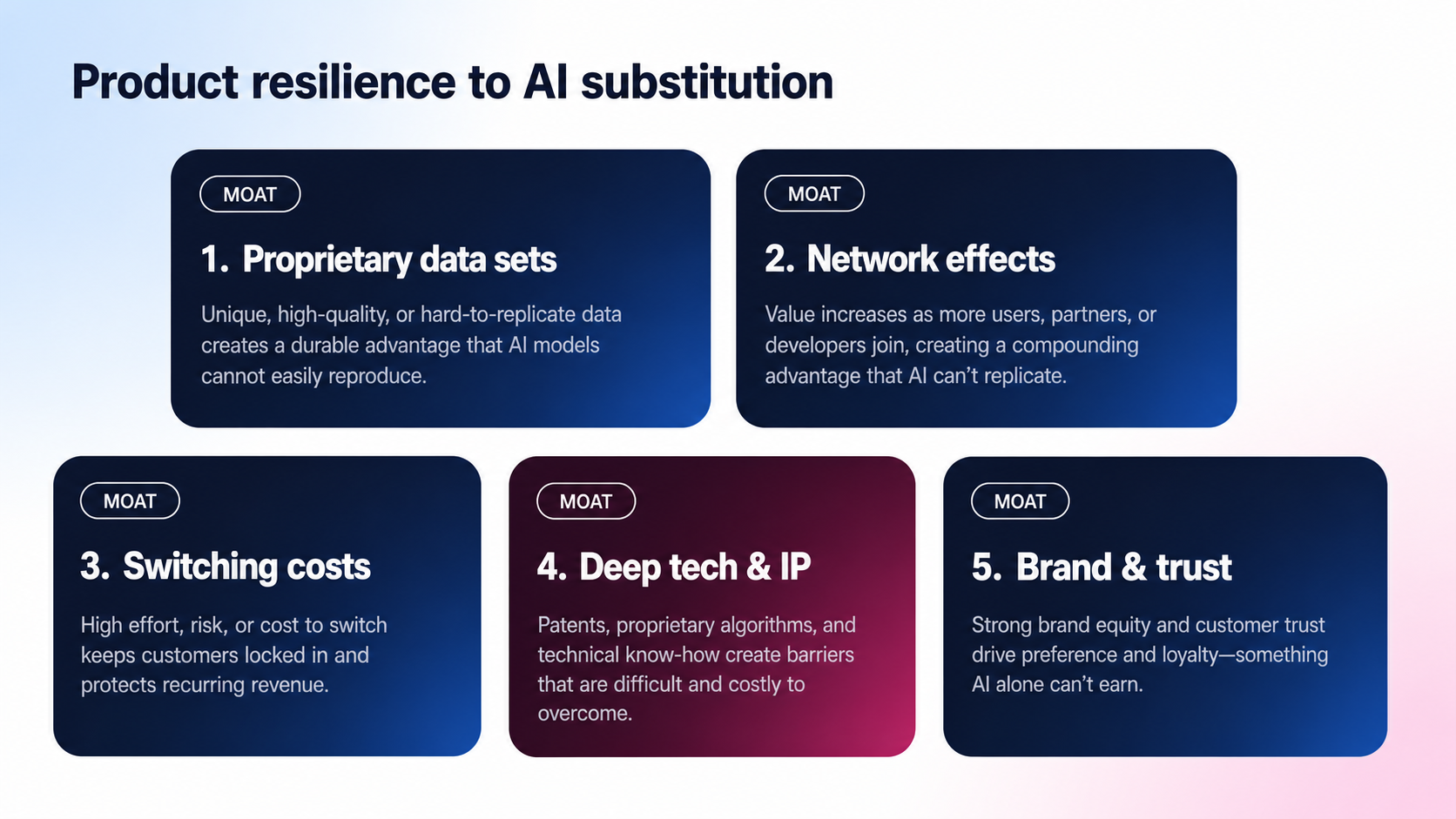
Proprietary data sets. AI learns from data. Companies holding unique, hard-to-replicate datasets – built through years of operations, specific customer interactions, or exclusive data partnerships – possess a structural advantage that publicly available AI models cannot easily copy. This data becomes the foundation of a durable competitive moat.
Network effects. When a product's value grows with its user base, a self-reinforcing loop emerges: more users generate more data, better data improves AI models, and improved models attract more users. Platforms where user interactions continuously enrich recommendation and prediction algorithms exemplify this dynamic.
Switching costs. Deep integration with a customer's business processes – through unique personalized models, embedded workflows, or accumulated institutional data – raises the barrier for switching providers substantially. The financial, operational, and time-related costs of migration become a meaningful entry barrier for competitors.
Deep tech and intellectual property. Proprietary algorithms, specialized AI models, patents, and advanced R&D methods provide a defensible technical edge. While open-source AI continues to democratize capabilities, the ability to build and evolve highly specialized solutions that address complex, domain-specific problems remains difficult to replicate.
Brand and trust. In environments where AI-generated errors carry real consequences – regulated industries, precision-critical applications, high-stakes decisions – trust in a brand's ability to deliver reliable and ethically sound AI is enormously valuable. Reputation built on consistent quality is a moat that commoditized AI tools cannot substitute.
Why both perspectives matter
AI Readiness and AI Resilience/Defensibility are complementary – and equally necessary. Readiness tells the story of internal potential: how well-positioned is this organization to extract value from AI going forward? Resilience tells the story of external durability: how protected is this business model from AI-driven disruption?
Together, they form a rigorous analytical framework for investment and acquisition decisions in a rapidly evolving technological landscape. Ignoring either dimension introduces material blind spots into the due diligence process.
Sources
- Baker Tilly — AI due diligence assessment prepares company for strategic acquisition
- RSM US — AI readiness assessment
- Greylock — The New New Moats
- Pivotal — Data and Defensibility
Key Questions About AI Due Diligence in M&A and Investment Processes
What is AI due diligence and why is it important in mergers and acquisitions?
AI due diligence is the process of assessing how artificial intelligence impacts a target company's operations, growth potential, and competitive position. It helps investors and acquirers understand whether a business is prepared to leverage AI effectively and whether its products can remain competitive as AI technologies evolve. As AI becomes a key driver of value creation, AI due diligence is increasingly considered a critical component of M&A and investment decisions.
How do you assess a company's AI readiness?
A company's AI readiness is evaluated across several dimensions, including AI strategy, data quality and governance, IT infrastructure, cybersecurity, risk management, regulatory compliance, and organizational culture. The goal is to determine whether the business has the capabilities, leadership support, and operational foundations needed to successfully implement and scale AI initiatives.
What is AI resilience and how can a company defend itself against AI disruption?
AI resilience refers to a company's ability to maintain its competitive advantage despite rapid advances in artificial intelligence. Organizations with proprietary data, strong network effects, high customer switching costs, unique intellectual property, and trusted brands are generally more resistant to AI-driven disruption. These factors create defensible competitive moats that are difficult for AI-native competitors to replicate.
What are the key risks investors should evaluate during AI due diligence?
Investors should assess risks related to data privacy, AI governance, regulatory compliance, cybersecurity, model reliability, ethical AI use, and talent availability. They should also evaluate whether the company's business model could be disrupted by generative AI, automation, or emerging AI-powered competitors entering the market.
How does AI due diligence influence company valuation?
AI due diligence can significantly affect valuation by identifying both growth opportunities and hidden risks. Companies with strong AI readiness and defensible AI-driven competitive advantages may command higher valuations because they are better positioned for future growth. Conversely, businesses that lack AI capabilities or face a high risk of AI substitution may experience valuation discounts during investment or acquisition processes.